
Original Face
What Chinese Medicine understands about beauty that the skincare world doesn't
I’ve been reading Becoming Wise: An Inquiry into the Mystery and Art of Living by Krista Tippett — a book a client recommended years ago that I am only now getting to.
Perhaps, as is often the case, the message was waiting for the right moment. Some words require more years of living before they can fully land.
In the book, Tippett explores the meaning of beauty. She writes:
"Culturally, beauty is one of those muddied words. Our minds have been trained to go to perfect bodies and flawless faces on the covers of magazines. But that, as the late great Irish poet and philosopher of beauty John O'Donohue helpfully distinguished, is glamour."
As someone who works on faces daily — helping women feel more radiant and more themselves — I am continually drawn to a definition of beauty that reaches beyond glamour. And as life carves into me the alternately frightening and profound experience of aging, I find the definition I am searching for keeps expanding.
Tippett continues:
"I've taken his definition as my own, for naming beauty in all its nuance in the moment-to-moment reality of our days: beauty is that in the presence of which we feel more alive."
As a practitioner, my work with the face has led me to modify this slightly:
Beauty is when we connect with the depths of our own aliveness.
Chinese Medicine offers a framework for understanding this, and I return to it often in my clinical work. Four concepts, in particular, illuminate what we’re really talking about when we talk about beauty:
The Original Face
In Taoism and Chinese Medicine there is a concept called Original Face. It encapsulates, in my mind, an answer to the anti-aging narrative. It embraces the face as a culmination of our lives, our embodiment of purpose, and it rests on the idea of evolution and change. Our faces will change as we journey through our lives, and this journey is unique to each of us.
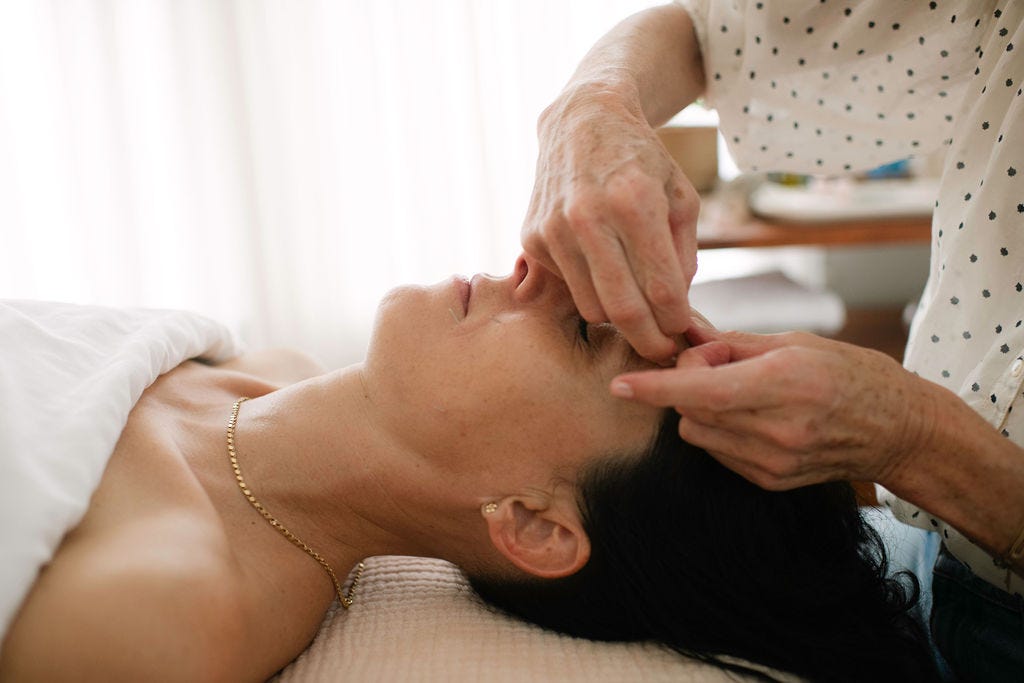
In my clinic, this is a transformation I see daily and it motivates my practice. It’s what surfaces when a person enters into deep rest during a treatment. The masks of stress, responsibility, and daily routine drop away, and women become re-aligned with their being.
Qi — the spark
Qi is the animating force — the vitality that moves through the body and reflects in the skin. In the face, we see it as engagement and presence. The sense that someone is genuinely inhabiting their own skin.
When Qi is abundant and flowing freely, a person looks alive in a way that has nothing to do with age.
Jing — the pivot from form to spirit
Jing is our constitutional essence, the deep reservoir we are born with. It is both physical and spiritual. Jing cannot be manufactured, only tended. How we live, rest, nourish ourselves, and move through the world either conserves it or exhausts it.
As the physical body ages, the non-material aspect of Jing becomes more visible. I think of this as a growth of wisdom and an enhancement of our inner world.
I see this in women in their 50s and 60s: a certain gravity and presence that simply isn’t available to younger faces. What we sometimes call “aging” is also the physical emergence of something spiritual that took decades to develop.
Blood — nourishment and self-acceptance
In Chinese Medicine, Blood is far more than its biomedical counterpart. It’s the liquid nourishment of our interior life. It anchors the spirit, moistens the tissues, and carries our emotional history. It expresses outward, most visibly in the face: in color, in plumpness, in a softness and ease that comes when the body is not in survival mode. Blood reflects how we care for ourselves.
Together, these four concepts point toward the same thing that Tippett and O’Donohue are circling: beauty is far greater than the limited realm of glamour.
In my experience, beauty is an integrated aliveness that transcends age.
What I find in practice is that when a woman begins to understand her unique beauty this way, her relationship to her own face begins to shift. She stops seeing beauty as strictly an external mandate.
The goal changes. Not glamour. Something closer to recognition and radiance.
For now, I think that is the work.
With care,
Margaret
Thank you. Informative and inspiring.
I look forward to you articles every week.